-
Lateral Reading: What is it, and why should I do it?
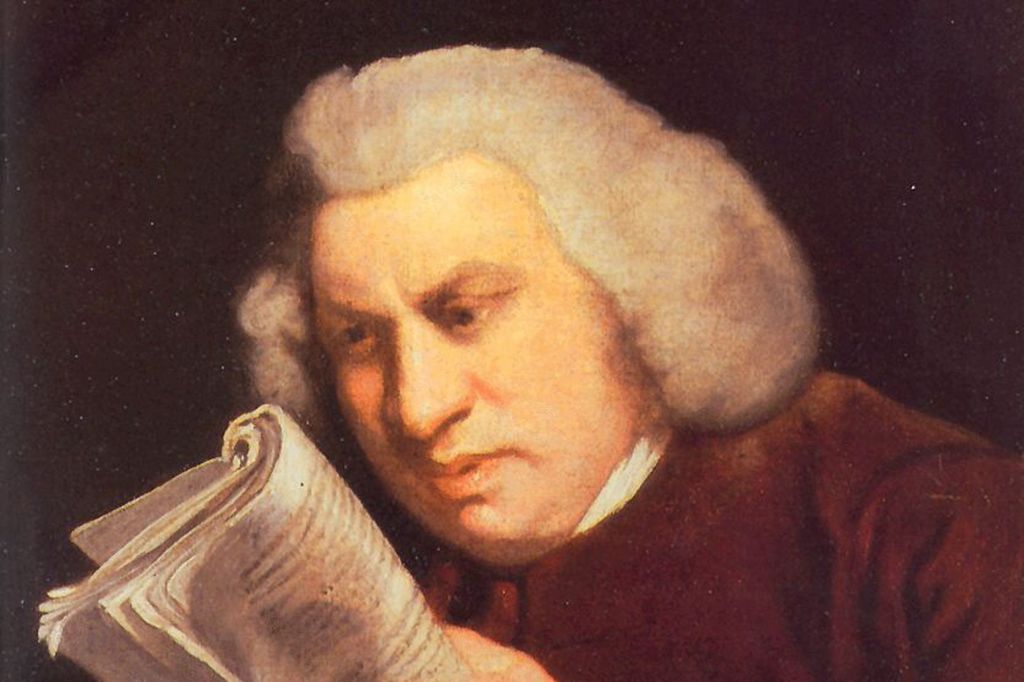
Portrait of Samuel Johnson, by Joshua Reynolds, 1775. In this digital age, information literacy is critical to the skillset that anyone should have. How to find information, and perhaps even more importantly, how to evaluate information online is crucial. Remember how “Fake News” became a byword not that many years ago?
A lot of librarians teach this aspect of information literacy with checklist type exercises. CRAAP is a common one, for example. CRAAP stands for Currency, Relevence, Authority, Accuracy, Purpose. As far as it goes, it’s a good start when evaluating a source. As long as I’m talking CRAAP, let me take a minute to elaborate on what it means, because it IS a useful tool.
Currency
- How old is this? Is it still recent enough to be relevant?
- Are the links active?
Relevance
- Does this answer my question / give me the information I’m looking for?
- Who is the intended audience?
- Does the information appear credible?
Authority
- Who is the author/creator/sponsor for this information?
- What are the author’s credentials?
- What are the author’s or website’s affiliations (i.e. what other organizations are they related to, funded by, employed by, etc.)
- Is the author qualified to write on this topic?
- Does the URL reveal anything about the author or information? (For example, .edu = educational institutions, .gov = government institutions, etc. BE CAREFUL WITH THIS! A given URL is not necessarily an indication of validity).
Accuracy
- Is this information subject to review by an editor, or peer reviewed in some way?
- Is the information supported by evidence such as references?
- Is the language of the information objective, or is it charged with emotion?
Purpose
- What is the purpose of this information? To inform? Entertain? To persuade?
- Is this intended to be factual or opinion?
- Do the author(s) make their purpose clear?
- Are there political, ideological, religious, instituational or personal biases evident?
Those are all good things we should have on our radar when looking for information. So, as far as it goes, CRAAP is a useful mental checklist to keep in mind, whether we’re actively searching online for information or just seeing a link shared by someone on social media.
But…that’s not all we can do.
So now I’m finally going to get to the point and am going to talk about Lateral Reading.
LATERAL READING
Most people read a website like they would a page in a book: from top to bottom.
But websites aren’t books. They have embedded links, they have sidebars with more information or with navigation to other parts of the site, etc. And even without embedded links or other navigation tools, there is often a lot of information that can be easily checked online.
Lateral reading is not just reading a webpage, but actively checking it while reading it. After reading a paragraph, you might click a link embedded in that paragraph and check out what is there.
If a paragraph refers to a person, or an event, or a research paper, or something of that nature, open a new tab and search – find out more about those things? Who is this person? Did this event really happen? Is this a legitimate peer-reviewed research paper? And so on.
You can even check what other sites say about the site you’re looking at. Or check the “About” link on the page, if there is one. If it’s a news story, do a search to see if other news outlets are reporting on it, and what they say. The key is, be willing to open new tabs, click links, and follow leads to see if what you’re reading is accurate, or to learn if there are biases in what you’re reading.
This is the method the best fact-checkers use, by the way. Don’t stay on one page. Don’t be afraid to have a dozen open tabs. Don’t be afraid to do your own searches to verify what you’re seeing on one page is supported by other sources.
As you do your lateral reading, by the way, keep your CRAAP (and it’s not the only such information literacy checklist with an acronym, there are others) checklist in mind, and you’ll find yourself much better able to evaluate the information in front of you – and in the end you will very likely end up with a much better understanding of what you’re reading about than if you just read top-to-bottom on the page and moved on.
“Back in the day,” when I was an undergrad History Ed major, I was pretty good at sussing out sources that other fellow students missed. Turns out I was doing a version of lateral reading before the days of the internet (well, the earliest days of the internet, anyway, when you’d have to go to the university computer lab to get “online”). I’d take notes, sure, but as I’d read I’d also just jot down a list of keywords, people’s names, events, no matter how obscure, flip back and forth between the source and the index (if there was one), or between books on the table in front of me and then head to the library catalog to search for sources on those keywords and people. And then I’d chase those down, rinse and repeat.
But back then, the books I was finding in the university library were subject to editorial review. Comparatively speaking, the online environment today is the Wild West, where literally anyone with a keyboard or smartphone and a wi-fi connection can hold forth on social media, or post in article comments, or even have their own blog (cough, cough). So it’s more important than ever to use these tools and keep your “radar up.”
If you want to know more about lateral reading, Stanford University has a good educational series of pages and videos about it. Newslit also has more information, as do many other sites. Browse around and test your new skills!
Until next time, folks. Stay Curious!
-
Book Review: Our Last Echoes
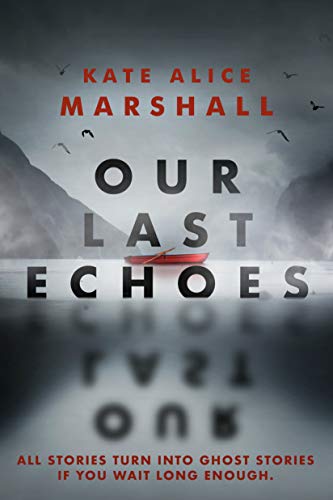
Our Last Echoes, by Kate Alice Marshall
Age range: Young Adult
Genre: Horror
On the island of Bitter Rock, near the coast of Alaska, people disappear. It’s been happening for over a century – sailors, soldiers, commune members, researchers – have disappeared, never to be heard from again. Officially, these disappearances are accidents. Unofficially…
Sophia had never heard of Bitter Rock until a mysterious phone call alerted her that there may be more to her mother’s death than she knew. That perhaps her mother didn’t simply die in the hospital miles from the ocean when Sophia was a child, but that she was among the missing from a place called Bitter Rock.
Obsessed with finding out what really happened to her mother, and why her life seems to be plagued by strange events (did her reflection really sometimes move independently of what she was doing, or was it just imagination?), Sophia wrangles a summer internship at the Landon Avian Research Center (LARC) on Bitter Rock Island, where she meets the small research team stationed there for the summer, but also meets Liam, the son of the lead researcher, and Abby, who seems to be chasing the mystery of the Bitter Rock disappearances for her own ends. And Sophia learns the one ironclad rule of the LARC: no one goes outside when the mists come down…
Fans of shows like Stranger Things or Lost will find a compelling mystery, told not only from the point of view of Sophia, but also interspersed with vignettes from research files on the odd disappearances tied to Bitter Rock, and so gradually revealing the story not just through Sophia’s view of current events on the island, but information bearing on the disappearance of Sophia’s mother from Bitter Rock in 1993. The jump from present to past and back can sometimes be a little jarring, but the book keeps a good pace and provides a lot of mystery with a dose of suspense and horror. And while the story is wrapped up sufficiently in the end for this tale, room is definitely left open for a potential sequel.
-
Hello World!
Welcome to Stay Curious, my foray into blogging about, as the tagline says, books, critical thinking and librarianship, and whatever else comes to mind as worthy of blogging about.
Why? Well, I’d like to think that maybe, at least a few people might read this and benefit from it. And if nothing else, it gives me somewhere to put stuff that’s in my brain.
Why books and librarianship? Because I’m a librarian. Why critical thinking? Because I’m a librarian. People have the misconception that being a librarian entails little more than shelving books, shushing people, and maybe reading books in between bouts of the two. That’s… a little simplistic.
The fact is, being a qualified librarian requires a fair amount of education – as in, Masters Degree level of education. My own degree is not the coveted MLIS (Master of Library and Information Studies) but rather a Master of School Library Studies — focused more specifically upon being a librarian/educator. That doesn’t diminish the work put into the degree, it simply means that while the coursework is mostly pretty parallel, mine has much more emphasis on education and teaching and working as a school librarian.
Obviously, if you’re earning an MA, that entails a lot more than “how to shelve a book.” And a lot of it has to do with information literacy – how to find and vet information. There is a reason why many public libraries have a reference desk. I’ve worked for a public library as well, and at the reference desk I answered questions as “simple” and varied as figuring out what the title was of a book a patron was trying to find, to fairly in-depth delves into the current happenings with the British Royal Family.
And critical thinking goes hand in hand with that. Part of evaluating information is knowing how to look at it critically and decide if it’s a valid source, what the source’s biases are, etc.
And as an educator, I want to teach people. I want to give them the skills they need to examine their own thinking, and to find information, and, yes, maybe find a good book along the way. I’m a secondary level librarian, so most of the books I’ll be looking at are going to be middle grades-to Young Adult-level in nature. But I might throw in the odd picture book, early chapter book, or adult book. You never know.
That’s it for now, I just wanted to get something down in writing, as that’s a major first step in this sort of venture. And while this first post is a little stream-of-consciousness and not polished or particularly edited, hopefully it gives an idea of what I hope to achieve with this blog, and as I have time to tweak it, it may become a little more elaborate than what you see here.
In any case, welcome, and I hope you’ll stick around for awhile to see what happens next.
Stay Curious
A blog of books, librarianship, critical thinking, and other musings.


